
Are your feet the weakest link in your active lifestyle? If you train regularly, run, hike, or stand for hours on end, foot care for active people is the one habit that separates those who stay consistent from those who get sidelined by preventable injuries. The answer isn't complicated — it comes down to the right gear, a few daily habits, and enough body awareness to catch problems early. This guide breaks down exactly what you need to know, from choosing footwear to long-term maintenance. Start exploring the full library at our foot care resource hub.

Your feet absorb three to four times your body weight with every stride — and that number climbs significantly during running, jumping, or hiking. Over months and years, the cumulative stress on tendons, skin, joints, and the plantar fascia is enormous. Neglect even one aspect of foot health and the whole system starts to show cracks. The encouraging reality is that prevention is far easier than treatment, and the steps you take now pay dividends for years.
Whether you're a weekend runner, a gym regular, or someone logging hours on hard floors, the principles are the same. You need the right equipment, a solid daily routine, and enough awareness to spot warning signs before they escalate. Let's break it all down.
Contents
Your shoes are the single most important piece of equipment in your foot care toolkit. A poorly fitted shoe — too narrow, too stiff, or worn past its useful life — is responsible for a disproportionate share of foot injuries. You need a shoe matched to your foot shape, your arch type, and the specific demands of your activity.
Running shoes are engineered for forward motion, cushioning the heel-to-toe transition over hundreds of miles. Cross-trainers offer lateral stability for gym movements. Hiking boots distribute load across uneven terrain. Using the wrong shoe for your activity is one of the fastest routes to plantar fasciitis, shin splints, or stress fractures. Get fitted at a specialty running store where staff can assess your gait before you commit to a pair.
Most stock insoles offer minimal arch support. If your feet pronate (roll inward) or supinate (roll outward), even a quality shoe may not compensate for the underlying biomechanical imbalance. Custom or semi-custom orthotics fill that gap precisely. According to the National Institute of Arthritis and Musculoskeletal and Skin Diseases, structural foot problems are a leading cause of lower-limb pain in physically active adults. If heel pain, arch fatigue, or knee discomfort are showing up during activity, reviewing the best orthotic insoles for your foot type is a logical next step.
When you've recently increased your activity level, your feet are in an adaptation phase. Muscles, tendons, and the plantar fascia that haven't been stressed before need time to build resilience. Doing too much too soon is the primary cause of overuse injuries in new athletes. Start with lower mileage or intensity, prioritize proper footwear from day one, and give your feet at least one full rest day per week.
You're also more likely to develop blisters early on before your skin toughens to repeated friction. Moisture-wicking socks and correctly sized shoes dramatically reduce that risk. If you're prone to flat arches, address it now rather than later — untreated flat feet under training load compound quickly. Read more about how to treat flat feet before they derail your progress.

Experienced athletes face a different set of risks: accumulated wear, chronic low-grade inflammation, and the temptation to push through pain signals that deserve attention. At this level, foot care for active people shifts from prevention to active maintenance. Regular podiatrist check-ins, periodic shoe replacement, and dedicated recovery protocols become non-negotiable. Black toenails, persistent heel pain, or numbness during exercise are signals your feet are sending — pay attention to them.
Pro insight: Replace your athletic shoes every 300–500 miles, or when the midsole feels noticeably less responsive. Worn cushioning is invisible from the outside but dramatically increases impact stress on your joints.
Choosing between footwear categories can feel overwhelming. The table below gives you a practical framework to match your activity with the right gear, so you're not guessing at the shoe store.
| Activity | Recommended Footwear | Insole Priority | Replacement Schedule |
|---|---|---|---|
| Road running | Neutral or stability running shoe | High — add arch support | Every 300–400 miles |
| Trail running | Trail shoe with lugged outsole | Medium — terrain absorbs load | Every 400–500 miles |
| Gym / weightlifting | Flat cross-trainer or lifting shoe | Low to medium | Every 12–18 months |
| Hiking | Mid-ankle hiking boot | High — orthotics reduce fatigue | Every 500–1,000 miles |
| High-impact classes | Cross-trainer with lateral support | Medium — depends on arch type | Every 9–12 months |
Use this as a starting point, not an absolute rule. Your foot mechanics and comfort take precedence over any generic recommendation. If plantar fasciitis is already part of your history, pairing the right shoe with a night splint or sleep support can significantly accelerate recovery between training sessions.
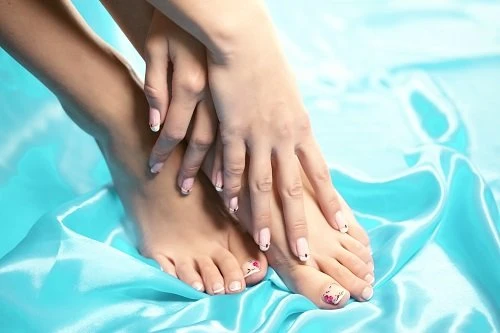
What you do immediately after exercise matters as much as what you do during it. Letting your feet air out after a workout is one of the most underrated habits in active foot care. Fungal infections like athlete's foot thrive in warm, moist environments — exactly what the interior of a sweaty shoe provides for hours after a session ends. Remove your shoes promptly, allow your feet to dry thoroughly between the toes, and rotate between at least two pairs of athletic shoes so each pair has a full 24 hours to dry between uses.
After longer runs or hikes, a cold water soak for 10–15 minutes reduces inflammation in the plantar fascia and Achilles tendon. Contrast therapy — alternating between cold and warm water for several cycles — improves circulation and helps clear metabolic waste from fatigued muscles. Neither approach takes more than 15 minutes, and both have a measurable effect on how your feet feel the next morning.
Trim your toenails straight across, not curved at the corners. Curved trimming is the leading cause of ingrown toenails in active people — and an ingrown nail under training load becomes painful fast. Keep the skin on your heels and the balls of your feet supple by applying a quality foot cream after showering. Dry, cracked skin on heels is more than cosmetic; deep fissures create entry points for bacteria and become genuinely painful during high-impact activity.
Warning: Never pop a blister without first cleaning the area with an antiseptic. An infected blister can sideline you for weeks, and in people with diabetes or compromised circulation, the risks are significantly more serious.
You don't need to spend a fortune to cover the basics. A pair of moisture-wicking athletic socks runs $8–$20. A pumice stone or foot file costs under $10. A solid foot cream is typically $10–$25. These three items alone address the most common issues active people face — blisters, dry skin, and fungal risk — for under $55 combined. Add an antifungal spray for your shoes (around $8–$12) and you have a complete low-cost daily kit.
Quality athletic shoes are the investment that pays back the most. Expect to spend $100–$180 for a running or trail shoe from a reputable brand. Spread over 400 miles of use, that works out to roughly $0.30–$0.45 per mile — a bargain compared to the cost of treating a preventable overuse injury. Semi-custom orthotics from specialty retailers are effective for most people at $40–$80, while custom orthotics from a podiatrist run $200–$500 for those with more complex biomechanical needs. Add an annual podiatrist visit ($100–$200 with insurance) and your total annual foot care budget for a serious athlete lands around $350–$600 — a fraction of what a single physical therapy course costs.
Flexible, strong feet resist injury far better than stiff, neglected ones. The plantar fascia, Achilles tendon, and intrinsic foot muscles all benefit from consistent daily attention. Calf stretches held for 30–45 seconds loosen the posterior chain that exerts constant tension on the heel. Toe spreads, towel scrunches, and single-leg balance holds build the intrinsic strength that supports every step you take under load.
Dedicate five minutes before and after each session to foot-specific mobility work. It's not the most exciting part of a training routine, but it's one of the highest-return habits you can build. Consistent foot strengthening reduces injury recurrence rates and improves overall lower-limb mechanics over time.
Persistent heel pain that's worst during your first steps in the morning is a classic plantar fasciitis symptom. Pain along the top of the foot following a mileage spike often signals a stress fracture. Numbness or tingling in the toes points toward nerve compression or circulation issues. None of these symptoms should be ignored or trained through without investigation. Early intervention — rest, ice, load modification, and professional assessment — prevents what might be a two-week setback from becoming a two-month one. Your feet communicate clearly; you just need to listen.
Most athletic shoes lose effective cushioning between 300 and 500 miles of use. If you notice increased soreness after workouts, visible midsole compression, or uneven outsole wear, replace them — regardless of how the upper material looks.
Moisture-wicking synthetic or merino wool socks reduce blister risk by keeping skin significantly drier than cotton. Look for a snug fit with no bunching and minimal toe seams. Double-layer socks are an effective option for high-friction areas like the heel and ball of the foot.
For most active people, high-quality semi-custom orthotics from specialty retailers provide comparable benefits to custom orthotics at a fraction of the cost. Custom orthotics become worthwhile when you have documented biomechanical issues — significant overpronation, structural flat feet, or conditions that haven't responded to off-the-shelf options.
Keep your feet clean and completely dry after every session, especially between the toes. Rotate your shoes to allow full drying between uses. Wear sandals in communal showers and locker rooms. At the first sign of itching or scaling between your toes, treat promptly with an antifungal cream to prevent the infection from spreading.
Minor muscle soreness after a hard session is normal and manageable. Sharp pain, swelling, bruising, or pain that worsens during activity are signals to stop training and assess the situation. Pushing through those specific symptoms converts minor issues into serious injuries that require weeks of enforced rest.
Focus on intrinsic foot muscle exercises: toe spreads, single-leg balance holds, towel scrunches, and short-foot contractions. Pair these with calf raises and Achilles stretches to support the full posterior chain. Consistency is the key factor — five minutes daily produces far better results than an occasional longer session.


About Mehnaz
Mehnaz is the founder and editor of RipPain, a health resource site dedicated to helping readers navigate pain management, recovery, and medical device research. Her work on the site is driven by personal experience caring for seriously ill family members, which led her to study evidence-based guidance from physicians, pain specialists, and published medical research. She curates and summarizes expert medical insights to make credible health information accessible to everyday readers.
You can get FREE Gifts. Or latest Free phones here.
Disable Ad block to reveal all the info. Once done, hit a button below
 Mehnaz