
Does the first step out of bed send a stabbing pain shooting through the bottom of your foot? That sensation is one of the most reliable hallmarks of plantar fasciitis — and the good news is that targeted heel pain treatment resolves the condition without surgery in the vast majority of cases. The key lies in correctly identifying the injured structure and applying a progressive, evidence-backed protocol with genuine consistency. For a broader foundation in foot health, our foot care hub covers everything from prevention to long-term recovery.
Heel pain affects approximately one in ten people at some point in their lives, making it one of the most prevalent musculoskeletal complaints seen in outpatient clinical settings. The structures most commonly involved — the plantar fascia, the Achilles tendon, and the small bursae cushioning the heel bone — each have distinct injury patterns and respond to fundamentally different interventions. Treating them identically under a generic "heel pain" label is one of the most common and costly mistakes people make, and it explains why so many off-the-shelf treatment plans fail to deliver lasting relief.
This guide is written for people who have already tried basic rest and ice and found them insufficient. What follows is a structured breakdown of the most common heel pain conditions, the treatment hierarchy from conservative to procedural, and the clinical rationale behind each approach — giving you a clear, actionable path from frustration to functional recovery.
Contents
Your calcaneus — the heel bone — sits at the convergence of several critical load-bearing structures. The plantar fascia runs along the entire sole from heel to toes, functioning as a tension band that supports your arch during the push-off phase of walking and running. The Achilles tendon attaches at the posterior surface of the calcaneus, transferring force from the calf complex into the foot. Small fluid-filled bursae reduce friction between the tendon and bone. When any of these tissues sustain repetitive microtrauma through overuse, sudden loading changes, or poor foot biomechanics, localized degeneration and pain follow.
Plantar fasciitis accounts for roughly 80% of heel pain diagnoses, but it shares the symptom list with Achilles tendinopathy, retrocalcaneal bursitis, calcaneal stress fractures, and tarsal tunnel syndrome. Each has a distinct clinical fingerprint. Misidentifying your condition means treating the wrong structure entirely. If you've been told you also have a bone spur, it's worth reading about what a heel spur actually is — because the spur itself is rarely the primary pain generator and is often an incidental finding.
Flat feet, high arches, and restricted ankle dorsiflexion range all increase tensile stress on the plantar fascia during normal gait. Rapid spikes in training load are classic triggers in runners and new exercisers alike. Prolonged standing on hard surfaces creates cumulative insult in healthcare workers, retail staff, and warehouse employees. What most patients overlook is that chronically tight calf muscles are among the most significant and correctable risk factors — the gastrocnemius and soleus pull on the Achilles and increase fascial tension with every step. Bodyweight also plays a direct mechanical role; even modest weight gain translates into substantially increased compressive and tensile forces through the heel.
The signature presentation is severe pain with the very first steps of the morning — a stabbing or burning sensation that gradually eases after a few minutes of walking, then returns after prolonged sitting or standing. Imaging typically shows degenerative collagen changes at the fascial insertion on the calcaneus rather than classical inflammation, which explains why anti-inflammatory medications provide only partial, temporary relief. The primary treatment driver is mechanical load management: reducing the tensile forces pulling on the fascial origin while progressively reloading it to stimulate tissue remodeling and healing.
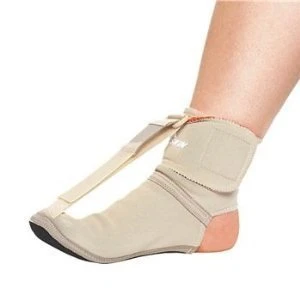
Night splints — like the Swede-O FXT device shown above — hold the ankle in dorsiflexion throughout sleep, maintaining a sustained low-level stretch on both the plantar fascia and Achilles tendon. Clinical studies consistently show that wearing a night splint reduces the severity of that notorious first-step pain, often dramatically. They are one of the most underused tools in patient self-care.
If you have diabetes, heel pain management requires extra vigilance. Peripheral neuropathy can blunt pain signals, allowing tissue damage to progress further before it registers. Before starting any aggressive stretching or footwear modification protocol, review the guidance in our resource on proper diabetic foot care to make sure your approach is appropriate for your specific situation.
Posterior heel pain — localized at the back of the heel rather than the bottom — points toward Achilles pathology. You'll typically notice pain and stiffness during and after physical activity, with pronounced morning stiffness that takes more than just a few steps to ease. The gold-standard intervention for midportion Achilles tendinopathy remains eccentric heel drop loading: lowering your heel slowly below step level under full body weight on an inclined surface, performed twice daily over 12 weeks. This protocol stimulates tendon remodeling in ways that concentric loading cannot. Insertional tendinopathy, where pain sits right at the bone attachment, responds less predictably to eccentrics and often requires a modified heavy slow resistance approach instead.
No conservative intervention carries a stronger evidence base for plantar fasciitis than daily stretching combined with progressive intrinsic foot muscle strengthening. The plantar fascia-specific stretch — pulling your toes back toward your shin — should be performed before your first weight-bearing step of the day, when the fascia is most vulnerable to microtrauma. Calf stretches targeting both the gastrocnemius with a straight knee and the deeper soleus with a bent knee address the entire biomechanical chain feeding tension into the fascial insertion. Three repetitions held for 30 seconds each, performed at minimum twice daily, is the clinical standard. Short-foot exercises and single-leg calf raises progressively rebuild the intrinsic foot and calf strength that offloads the fascia over time.
Footwear is not peripheral to heel pain treatment — it is structural medicine you wear every day. Supportive shoes with adequate heel cushioning, a firm arch contour, and a heel-to-toe drop of 8–12mm are a clinical prerequisite, not a lifestyle suggestion. Custom orthotics offer the most precise biomechanical correction for individuals with significant structural foot problems, but high-quality prefabricated devices provide meaningful and clinically validated relief for the majority of patients at a fraction of the cost. Walking barefoot or in completely flat shoes while symptomatic can negate the benefit of every stretch you perform. If your heel pain has also led to skin breakdown at the heel margins, address both simultaneously — our guide to the best foot cream for cracked feet covers protective and healing products that maintain skin integrity while you recover.
A physiotherapist with specific experience in lower limb biomechanics and tendon pathology brings a toolkit that no self-directed home program can replicate. Instrument-assisted soft tissue mobilization breaks down fascial adhesions. Dry needling targets trigger points within the calf and intrinsic foot muscles that perpetuate loading dysfunction. Gait retraining corrects the stride mechanics contributing to heel overload in the first place. Low-Dye taping provides immediate mechanical offloading and can serve as a diagnostic test — if taping provides rapid relief, orthotics are very likely to help long-term. These interventions produce the most durable results when combined with a consistent home exercise program between sessions. Commit to a minimum of 6–8 weeks before evaluating whether the protocol is working.
The data is clear: approximately 90% of plantar fasciitis cases resolve with conservative management within 6 to 12 months when treatment is applied consistently and correctly. Conservative care is not passive waiting or benign neglect — it is active, structured loading combined with footwear optimization and mechanical unloading during peak stress periods. The table below summarizes the primary treatment options available, their clinical evidence grade, and realistic timelines for expecting results.
| Treatment | Best For | Evidence Level | Typical Timeline |
|---|---|---|---|
| Plantar fascia stretching | Plantar fasciitis | Strong (Level I) | 4–8 weeks |
| Eccentric heel drops | Achilles tendinopathy | Strong (Level I) | 8–12 weeks |
| Night splints | Plantar fasciitis (morning pain) | Moderate (Level II) | 4–6 weeks |
| Prefabricated orthotics | Both conditions | Moderate (Level II) | Immediate–6 weeks |
| Custom orthotics | Complex biomechanics | Moderate (Level II) | 4–8 weeks |
| Corticosteroid injection | Refractory plantar fasciitis | Short-term (Level II) | Days–weeks |
| Shockwave therapy (ESWT) | Chronic plantar fasciitis / Achilles | Strong (Level I) | 6–12 weeks post-treatment |
| PRP injection | Plantar fasciitis / Achilles | Emerging (Level II) | 8–12 weeks |
Corticosteroid injections offer rapid short-term relief for refractory plantar fasciitis, but repeated injections carry a documented risk of fascial rupture — a complication that trades chronic ache for an acute structural injury with a longer, more complicated recovery. Use them judiciously and not more than twice. Extracorporeal shockwave therapy (ESWT) is the preferred escalation for cases that fail 3–6 months of properly applied conservative care, backed by Level I evidence for both plantar fasciitis and midportion Achilles tendinopathy. Platelet-rich plasma injections show promising results in emerging trials, particularly for those who have not responded to shockwave. Surgery — plantar fascia release or Achilles tendon debridement — is reserved for cases that genuinely fail all conservative and minimally invasive options over 12 or more months. According to the National Institute of Arthritis and Musculoskeletal and Skin Diseases, the overwhelming majority of patients recover fully without surgical intervention.
If your heel pain is recent — onset within the past four to six weeks — load management and consistent stretching should be your entire focus before adding any other interventions. Reduce but do not eliminate weight-bearing activity; complete rest weakens the very structures you need to heal. Swap flat footwear for supportive shoes with cushioning immediately. Begin the plantar fascia stretch and calf program twice daily without exception, and apply ice for 10–15 minutes after activity if localized soreness persists. These straightforward steps resolve a substantial percentage of acute presentations when applied with real discipline.
Chronic heel pain — symptoms persisting beyond three months — requires a fundamentally different approach. Passive rest at this stage accomplishes nothing; progressive tendon and fascial loading is what drives tissue remodeling in a chronically degenerated structure. If you have not yet worked with a physiotherapist, this is the point at which that becomes non-negotiable. Add heavy slow resistance loading progressively and review your entire lower limb chain — hip abductor weakness and limited hip extension force compensatory mechanics through the foot that perpetuate the injury cycle. Shockwave therapy becomes the appropriate clinical conversation at the 3–6 month mark when conservative care has been consistent but insufficiently effective. Do not let the chronic label become an excuse for accepting permanent limitation.
Effective heel pain treatment is not guesswork — it is a structured, evidence-based process that begins with identifying the right structure and applying the correct loading protocol with daily consistency. If you've been managing this for weeks or months without meaningful improvement, the most productive next step is scheduling an assessment with a physiotherapist who specializes in lower limb conditions and committing fully to the conservative program before considering any procedural options. Your heel is designed to recover — and with the right approach, it does.


About Mehnaz
Mehnaz is the founder and editor of RipPain, a health resource site dedicated to helping readers navigate pain management, recovery, and medical device research. Her work on the site is driven by personal experience caring for seriously ill family members, which led her to study evidence-based guidance from physicians, pain specialists, and published medical research. She curates and summarizes expert medical insights to make credible health information accessible to everyday readers.
You can get FREE Gifts. Or latest Free phones here.
Disable Ad block to reveal all the info. Once done, hit a button below
 Mehnaz