
After spending weeks searching for a cardio option that wouldn't wreck her knees, a close friend of mine finally bought a foldable stationary bike on a whim — and called me two weeks later saying it had changed her entire routine. That kind of word-of-mouth endorsement is hard to ignore. If you've been browsing the sport and fitness category for something low-impact, space-efficient, and genuinely usable, the Marcy foldable exercise bike belongs at the top of your shortlist — and this guide covers everything you need to evaluate it honestly before spending a dime.

The Marcy NS-652 and similar models in the Marcy foldable lineup have earned a devoted following among home exercisers who need low-impact cardiovascular training without committing to a full-sized machine. Whether you're managing lower back pain, recovering from an injury, or fitting workouts into a studio apartment, this bike hits checkboxes that pricier options sometimes miss — particularly the semi-recumbent seating position that takes pressure off your lumbar spine and distributes it more evenly through your hips and glutes. The combination of adjustable magnetic resistance, a genuinely foldable frame, and an accessible price point makes it a serious competitor in the budget home fitness space.
Before you add it to your cart, though, you need to understand both its real strengths and its actual limitations — because not every foldable bike is built the same way, and the Marcy model has specific characteristics that will either suit your situation perfectly or point you toward a different option entirely. Let's get into all of it.
Contents
The Marcy foldable exercise bike uses a semi-recumbent design — you sit with your legs extended forward at a comfortable angle rather than directly below your hips the way you'd sit on an upright spin bike. This positioning significantly reduces compressive load on the knees and lumbar vertebrae, which is the primary reason physical therapists and pain management specialists often recommend this style for patients who can't tolerate standard upright cycling. The steel frame supports users up to 265 pounds and holds up well under consistent daily use, though it isn't engineered for the punishment of a commercial-grade gym environment.
The onboard LCD console tracks time, distance, speed, calories burned, and heart rate via handlebar pulse sensors — it's not a touchscreen and it's not Bluetooth-enabled, but it delivers every metric a beginner-to-intermediate user actually needs without burying you in complexity. The 8-level magnetic resistance system operates quietly and smoothly, producing only a faint hum from the flywheel that won't disturb a conversation or a sleeping household member.
| Resistance Level | Intensity | Best For | Approx. Calories / 30 Min |
|---|---|---|---|
| 1–2 | Very Light | Warm-up, active recovery, seniors, post-injury rehab | 80–115 |
| 3–4 | Light to Moderate | Steady-state cardio, beginners building base fitness | 120–165 |
| 5–6 | Moderate | Fat-burning zone, intermediate endurance work | 170–215 |
| 7–8 | High | Interval training, advanced conditioning sessions | 220–275 |
Calorie figures vary based on your bodyweight and pedaling cadence, but they give you an accurate-enough benchmark for planning your workout intensity across different sessions and goals.
The single biggest mistake people make with semi-recumbent bikes is treating seat adjustment as an afterthought rather than the foundation of every safe and effective session. Your legs should reach a slight bend — roughly 5 to 10 degrees — at the very bottom of each pedal stroke, never fully locking the knee out, and never forcing a cramped acute angle at the top either. The Marcy foldable exercise bike offers multiple adjustment points most users never explore beyond the default position it ships in.
If your knees track outward during pedaling, your seat is too close to the pedals — slide it back one notch and recheck your knee alignment before continuing the session.
Foldable bikes tempt people into daily marathon sessions because they're right there in the living room and require zero commute — and that accessibility is exactly how overuse injuries sneak up on enthusiastic beginners. Start with 20-minute sessions at resistance levels 2 or 3, three times per week, then add five minutes or one resistance level every two weeks as your body adapts to the movement pattern. If you're managing fibromyalgia or a chronic fatigue condition, pairing your new exercise routine with better sleep strategies makes a measurable difference — how to get deep sleep with fibromyalgia is worth reading before you start, because recovery quality determines how much benefit each session actually delivers.
The Marcy bike works best as one component of a broader low-impact fitness strategy rather than your single piece of cardio equipment for years on end. If you're evaluating all your options for a space-efficient home setup, understanding what the best rowing machine under $300 and the stair stepper offer alongside a foldable bike will help you make a smarter investment decision — rotating between two low-impact modalities prevents adaptation plateau and keeps your sessions mentally fresher over time.
Marcy ships the bike partially pre-assembled, and the remaining steps typically take 30 to 45 minutes without any special tools beyond what's included in the box. The printed manual is clearer than most budget fitness brands manage to produce, though watching a YouTube walkthrough alongside it will shave time off the pedal and handlebar attachment steps where the manual diagrams get slightly ambiguous.
Run through this checklist before every session, especially during the first two weeks while you're still dialing in your personal setup, and you'll prevent the small mistakes that cause big problems down the line.
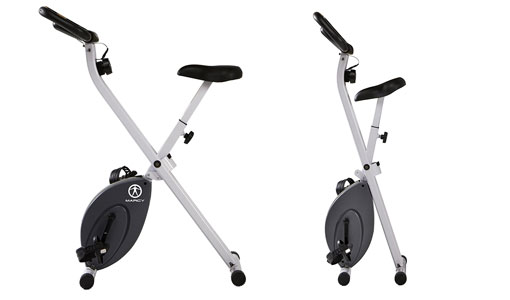
The CDC physical activity guidelines for adults recommend at least 150 minutes of moderate-intensity aerobic exercise per week, and the Marcy foldable exercise bike is one of the most practical tools available for hitting that target entirely within your home — no gym membership, no commute, and no weather excuses standing between you and your session.
The Marcy bike is genuinely low-maintenance compared to friction-based or belt-drive machines, but low-maintenance does not mean zero-maintenance, and ignoring the basics leads to squeaks, frame wobble, and degraded resistance accuracy within just a few months of regular use. Build a simple monthly maintenance ritual now before problems develop, and this bike will stay in solid working condition for years.
Pushing straight to Level 6 or 7 because the lower levels feel insufficiently challenging is one of the fastest routes to knee irritation, hip flexor strain, and IT band inflammation — especially for users returning to exercise after a sedentary period. Your cardiovascular system adapts to new demands within days, meaning your lungs and heart feel ready for higher intensity long before your tendons, cartilage, and joint capsules have caught up. Connective tissue adaptations take weeks to months, and no amount of motivation accelerates that biological timeline.
Semi-recumbent seating reduces spinal loading significantly compared to upright cycling, but it does not eliminate the postural demands of sustained exercise entirely. Sliding down into the backrest and rounding your lower lumbar spine shifts compressive force directly onto the intervertebral discs — and if you already deal with back pain, that pattern will reverse your progress faster than any training benefit the bike provides. Keep your core lightly activated throughout every session — not braced aggressively, but gently supportive and engaged against the backrest rather than collapsing into it.
This is the most persistent misconception in the compact fitness equipment space, and it's completely wrong. The magnetic resistance system on the Marcy foldable exercise bike generates legitimate cardiovascular challenge — at Level 7 or 8 with a brisk cadence, your heart rate will climb comfortably into the aerobic training zone, you'll sweat, and you'll feel genuine muscular fatigue in your quads and hamstrings after a 30-minute session. The folding mechanism affects storage convenience, not performance output. Don't let the compact form factor trick you into underestimating what this machine actually delivers.
Semi-recumbent foldable bikes absolutely serve rehabilitation and senior fitness populations — and they do it exceptionally well — but that demographic doesn't own the category. Younger athletes use these bikes for active recovery days between heavy training sessions, apartment dwellers use them as their primary cardio tool, and busy professionals use them for short desk-break sessions that would be impractical with full-sized equipment. The semi-recumbent hip angle actually facilitates stronger quadriceps drive at higher resistance levels compared to a standard upright bike, because the extended leg position allows a more powerful push through the bottom of the pedal stroke rather than cutting the range of motion short.
The folding joint on the Marcy bike is reinforced specifically to withstand repeated open-and-close cycles over years of regular use — it isn't a hinge that's meant to be set once and forgotten, but it's also not a fragile mechanism that will fatigue after a season of daily folding. The steel frame construction supporting a 265-pound weight capacity alone confirms that structural integrity was a primary engineering priority, not an afterthought sacrificed at the altar of portability. This won't feel like a $1,500 commercial machine — and it shouldn't at this price point — but within its category, the build quality is genuinely solid and appropriate for the load it's designed to carry.
The Marcy foldable exercise bike delivers exactly what it promises — low-impact cardio, space-efficient storage, and a genuinely accessible entry point into consistent home fitness, particularly for anyone managing chronic pain, limited space, or a budget that doesn't stretch to premium equipment. If this guide has given you the clarity you needed, take the concrete next step: order the bike, spend one afternoon on assembly, and commit to three 20-minute sessions this week before you evaluate whether the investment is paying off — because the results this machine delivers are entirely proportional to the consistency you bring to it.


About Mehnaz
Mehnaz is the founder and editor of RipPain, a health resource site dedicated to helping readers navigate pain management, recovery, and medical device research. Her work on the site is driven by personal experience caring for seriously ill family members, which led her to study evidence-based guidance from physicians, pain specialists, and published medical research. She curates and summarizes expert medical insights to make credible health information accessible to everyday readers.
You can get FREE Gifts. Or latest Free phones here.
Disable Ad block to reveal all the info. Once done, hit a button below
 Mehnaz