Are you searching for a machine that delivers a true full-body cardio workout without wrecking your joints or your budget? The good news: the best elliptical machines under $1000 are more capable than most people expect. Today's mid-range ellipticals pack features once reserved for commercial gym equipment — adjustable resistance, structured workout programs, heart rate monitoring, and smooth, low-impact strides. Whether you're managing lower back pain or building a home gym from the ground up, the right elliptical is one of the smartest investments you can make.
This guide covers the top four picks in the under-$1000 category, the specs that actually matter, common pitfalls to avoid, and a realistic approach to building lasting results. By the end, you'll know exactly which machine fits your body, your space, and your goals.
If you've already explored options like recumbent bikes or other seated cardio equipment, you'll appreciate how an elliptical uniquely engages both your upper and lower body at the same time. That dual-action design burns more calories per session while keeping stress off your knees, hips, and spine — a critical advantage if you exercise around a chronic condition or ongoing injury.
How to Find the Best Elliptical Machines Under $1000 for Your Needs
Shopping in this price range means navigating a crowded field. Not every elliptical earns its price tag. Here's what separates machines you'll use for years from ones that gather dust after three weeks.
Stride Length
18–20 inches is the sweet spot for most adults between 5'3" and 6'2".
A stride that's too short forces an unnatural gait, increasing joint stress rather than reducing it.
Taller users (6'2"+) should prioritize 20-inch stride models — never compromise here.
Resistance and Incline
Look for at least 20 resistance levels to support both beginners and advanced users within the same household.
Powered incline adjusts automatically mid-workout. Manual incline requires you to stop and reset — less convenient, but still effective.
Incline variation recruits your glutes and hamstrings more aggressively, adding training diversity without extra equipment.
Flywheel Weight and Stability
A heavier flywheel — 13 lbs or more — produces smoother, more consistent pedal motion.
Light flywheels feel jerky, which strains joints and makes longer sessions uncomfortable.
Check the maximum weight capacity. Most quality sub-$1000 models cap at 300 lbs; verify before purchasing.
Quick Specs Comparison
Feature
Minimum to Accept
Better Option
Stride Length
18 inches
20 inches
Resistance Levels
16 levels
20–25 levels
Flywheel Weight
13 lbs
15–20 lbs
Incline Type
Manual (fixed positions)
Powered (motorized)
Workout Programs
16 programs
22–29 programs
User Profiles
1–2
4+
Also check Bluetooth connectivity. According to research on elliptical trainers, app-integrated machines significantly improve long-term adherence by allowing you to track and visualize progress over time.
Our Top 4 Picks: Best Elliptical Machines Under $1000 Reviewed
These four machines represent the strongest value in the under-$1000 range across different user types, body sizes, and fitness goals. Each one earns its place for a distinct reason.
1. Schwinn 430 Elliptical
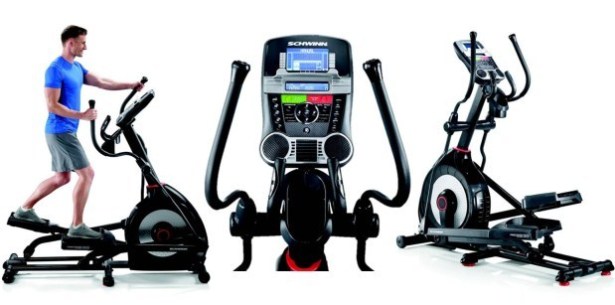
The Schwinn 430 is the benchmark in this price range. It's built for daily use, supports up to 300 lbs, and comes packed with features competitors charge extra for.
22 built-in workout programs
20 levels of magnetic resistance
20-inch stride length with large articulating footpads and cushioning
Manual incline with 10-degree range across 6 positions
Built-in fan, speakers, USB charging, and water bottle holder
2 user profiles, tablet holder, LCD console
2. Schwinn 470 Elliptical
If you want to step up from the 430, the 470 adds powered incline, Bluetooth app connectivity, heart rate telemetry, and 4 user profiles. It's the stronger choice for households with multiple serious users.
Schwinn 430 elliptical machine Vs. schwinn 470 elliptical machine
* Cross Trainer * Magnetic Resistance * 20 Resistance Levels * Manual Incline * LCD Console * USB Charging Port – – – – – – * 22 Workout Programs * Max Weight: 300 lbs. * Tablet/Book Holder * 20-inch Stride * Built-in Fan * Built-in Speakers * Water Bottle Holder * 2 User Profiles Schwinn 430elliptical machine
* Cross Trainer * Magnetic Resistance * 25 Resistance Levels * Powered Incline * Backlit LCD Console * USB Charging Port * Bluetooth with APP * Heart Telemetry * 29 Workout Programs * Max Weight: 300 lbs. * Tablet/Book Holder * 20-inch Stride * Built-in Fan * Built-in Speakers * Water Bottle Holder * 4 User Profiles schwinn 470 elliptical machine
Schwinn 430 elliptical machine Vs. schwinn 470 elliptical machine
3. Teeter FreeStep Recumbent Cross Trainer
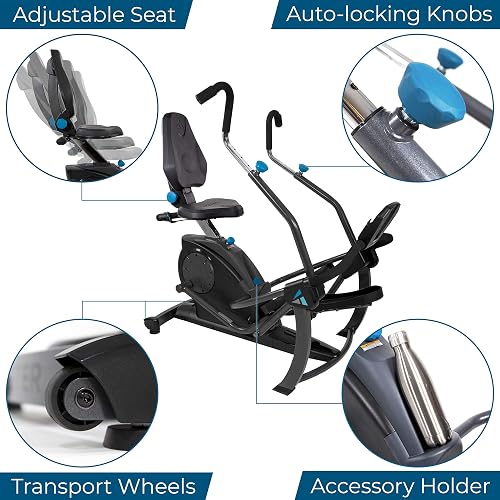
The Teeter FreeStep is a different animal entirely. It merges a recumbent seated position with elliptical motion — making it the top pick if you're dealing with hip, knee, or back issues. Zero knee-over-toe movement means virtually no anterior knee stress, a critical advantage for pain sufferers and rehab patients.
Recumbent seated position eliminates spinal compression during cardio
Independent arm and leg motion lets you isolate upper or lower body
Smooth cable-driven resistance mechanism with no abrupt transitions
Best fit for seniors, post-surgical users, or anyone with lower-extremity pain
4. Nautilus E616 Elliptical
The Nautilus E616 is the programming powerhouse on this list. It delivers 29 built-in programs, 25 resistance levels, Bluetooth connectivity, and a perimeter-weighted flywheel that produces one of the smoothest rides in this price category. If maximum variety and data tracking are your priorities, the E616 wins.
Here's how the Schwinn 430 stacks up against a NordicTrack model in the same price tier — two of the most commonly compared machines in this category:
Programs 22
Programs 20
Large articulating with cushioning
Oversized pedals
FAN
No FAN
10 degree manual ramp range with 6 positions
5-position ramp incline between 0 and 20 degrees
High speed high inertia perimeter weighted flywheel
15 Lb. Inertia-Enhanced Flywheel
nordictrack vs schwinn elliptical
How to Use Your Elliptical for Maximum Benefit
Buying the right machine is step one. Using it correctly determines whether you actually see results — or just spin your wheels for months without meaningful progress.
Proper Form on the Elliptical
Stand tall — keep your chest lifted and your core engaged throughout every stride.
Push and pull the handlebars actively. Don't just rest your hands there; use them to engage your upper body.
Keep your feet flat on the footpads at all times. Letting your heels lift shifts stress to your knees.
Look forward, not down. Dropping your chin rounds your thoracic spine and strains your neck.
Distribute your weight evenly across both feet — a slight forward lean is fine; hanging your weight on the arms is not.
Workout Structure by Experience Level
Beginners: 20–25 minutes at moderate resistance (levels 5–8), three times per week.
Intermediate: 30–45 minutes with resistance variations, four to five times per week.
Build in interval training — alternate 2 minutes at high resistance with 1 minute at low resistance. This accelerates cardiovascular adaptation.
Increase either duration or resistance by no more than 10% per week to prevent overuse injuries.
For cross-training variety, combining elliptical sessions with manual treadmill workouts produces strong results — the treadmill builds raw lower-body strength while the elliptical develops cardiovascular endurance and supports joint recovery simultaneously.
Quick Wins: Simple Adjustments That Deliver Faster Results
You don't need to overhaul your entire routine to get better output. These small changes make an immediate, measurable difference in the quality of every session.
Reverse your stride direction. Pedaling backward places significantly greater demand on your glutes and hamstrings than forward motion alone.
Release the handrails for 1–2 minutes per session. This activates your core stabilizers and burns additional calories without adding time.
Increase your incline by two positions every third workout. Different incline angles recruit different muscle fibers in your legs and hips.
Target your heart rate zone. For fat burning, stay in zone 2 — roughly 60–70% of your maximum heart rate.
Monitor your RPM. Aim for 140–160 revolutions per minute for efficient cardiovascular conditioning without sacrificing form.
Always warm up for five minutes at low resistance. It delays fatigue onset and significantly reduces early-session injury risk.
Each of these adjustments costs you zero extra time. You're making the same investment — just getting substantially more return on it.
Elliptical Mistakes You Need to Stop Making
Most people underperform on the elliptical not because of the machine, but because of how they use it. These are the most common errors — and exactly how to correct them.
Leaning on the handrails for support. This offloads effort from your legs and core, drastically reducing calorie burn. Use the rails for balance only.
Keeping the same resistance every single session. Your body adapts within weeks. If the workout feels comfortable, it has stopped producing results — increase resistance or duration.
Ignoring the incline setting entirely. Flat elliptical motion is fine for recovery days, but it won't build lower body strength efficiently. Rotate incline levels throughout your week.
Hunching forward over the console. Poor posture restricts breathing, reduces power output, and increases spinal stress over time.
Prioritizing speed over resistance. Fast pedaling at low resistance looks impressive but delivers minimal muscular benefit. Slow down and add load.
Skipping rest days because the elliptical feels "easy." Low-impact does not mean no-impact. Your muscles still require recovery time to repair and grow stronger.
Keeping Your Elliptical in Peak Condition
A well-maintained elliptical lasts ten or more years. Neglect it and you'll face expensive repairs or premature replacement. Consistent maintenance takes under fifteen minutes per month.
Cleaning and Lubrication
Wipe down the handles, footpads, and console with a damp cloth after every session. Sweat corrodes metal components and degrades electronic contacts over time.
Lubricate rails and pivot points every three months using silicone-based lubricant — never WD-40, which damages plastic parts and leaves a residue that attracts dust.
Position your machine on a hard floor or equipment mat, not bare carpet. Carpet fibers clog the mechanical components and generate static that harms the console.
Monthly Inspection Checklist
Check and tighten all bolts and screws — vibration from regular use gradually loosens hardware at every joint.
Listen for clicking or grinding sounds. These signal a loose pedal arm, worn bearing, or misaligned ramp — all fixable early, costly if ignored.
Inspect the power cord and console connections quarterly for fraying, kinking, or loose pins.
Test resistance across the full range every few months to catch magnetic brake or motor issues before they worsen.
Fixing Common Elliptical Problems Before They Derail You
Even quality machines develop issues over time. Most problems are easy to diagnose and fix yourself — no technician required.
Squeaking noise: Dry pivot points are almost always the cause. Apply silicone lubricant to all moving joints. If it continues, inspect the pedal arm bolt for looseness.
Resistance not responding: Check the console connection first. If the display works but resistance doesn't change, inspect the magnetic brake cable for wear or disconnection.
Wobbly or unstable stride: Tighten all frame bolts systematically. If instability continues, check the leveling feet — uneven floor contact causes the entire frame to rock.
Console not powering on: Inspect the power adapter and cable connection. Most consoles use a standard AC adapter; a replacement costs under $20 and resolves 90% of console power issues.
Inaccurate heart rate readings: Clean the contact grip sensors with a damp cloth. Dry or dirty contacts produce erratic data. If the problem persists, switch to a chest strap monitor for reliable readings.
Address these issues the moment you notice them. A minor mechanical problem becomes a major repair if you ignore it for several sessions.
Final Thoughts
The best elliptical machines under $1000 give you everything you need to build a consistent, sustainable cardio routine from home — without sacrificing quality or performance. Browse our full sport and fitness section for more equipment reviews, training guides, and product comparisons. Pick the machine that fits your goals, set it up correctly, and commit to a structured schedule — your cardiovascular health, your joints, and your long-term fitness will all be better for it.
Mehnaz is the founder and editor of RipPain, a health resource site dedicated to helping readers navigate pain management, recovery, and medical device research. Her work on the site is driven by personal experience caring for seriously ill family members, which led her to study evidence-based guidance from physicians, pain specialists, and published medical research. She curates and summarizes expert medical insights to make credible health information accessible to everyday readers.





 Mehnaz
 – – –
– – –