
A colleague of mine spent three months recovering from a herniated disc and wanted to stay active without risking further injury at the gym. Her physical therapist suggested gentle treadmill walking as part of her rehab. She was amazed to find that the best treadmills under $1000 could handle everything she needed — and then some. If you've been putting off a home treadmill because of the price, this guide is for you. Browse everything we cover in fitness equipment at our Sport & Fitness section, from treadmills to cardio bikes and beyond.
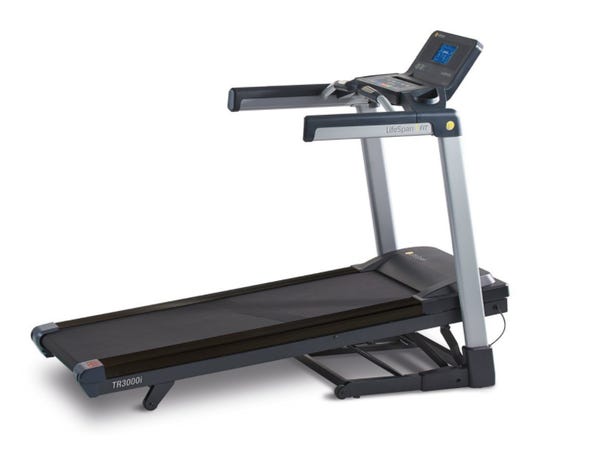
The sub-$1000 treadmill market has genuinely improved. Competition has pushed quality upward, and you no longer need to spend $2,000 to get a reliable motor, a durable belt, and enough features to keep your workouts interesting. What separates a smart buy from a regrettable one is understanding which specs actually matter for your body and your goals — and which are just marketing noise.
This guide walks you through five solid models in depth, starting with a side-by-side comparison so you can immediately spot which machine fits your needs. Whether you're managing lower back pain and need a gentle walking routine, rebuilding cardio after an illness, or simply staying active at home on your own schedule, there's a strong option here for you.
Contents
Before diving into each model in detail, it helps to see them all at once. The table below covers the numbers that matter most: motor output, top speed, incline range, weight capacity, and whether the machine folds for storage. Use it as your first filter — any model that doesn't match your weight or space needs can be ruled out quickly.
| Model | Motor | Max Speed | Max Incline | Weight Capacity | Foldable |
|---|---|---|---|---|---|
| NordicTrack 6.5S | 2.6 CHP | 10 mph | 10% | 300 lbs | Yes |
| Nautilus T616 | 3.0 CHP | 12 mph | 15° | 350 lbs | Yes |
| Sunny SF-T7515 | 2.5 HP | 9 mph | Flat only | 220 lbs | Yes (flat) |
| ProForm 505 CST | 2.5 CHP | 10 mph | 10% | 300 lbs | Yes |
| Schwinn 830 | 2.75 CHP | 12 mph | 12% | 300 lbs | Yes |
Motor power is listed in continuous horsepower (CHP) — this is the sustained output during use, not a one-time peak figure. For walking, 1.5–2.0 CHP is enough. For regular jogging, 2.5 CHP is the minimum you want. Incline range is worth your attention too: even a modest 5% grade at walking pace burns meaningfully more calories than flat walking, and it puts less stress on your knees than running. The CDC recommends at least 150 minutes of moderate aerobic activity per week — incline walking fits that prescription well and is gentler on joints than jogging.
The NordicTrack 6.5S consistently lands near the top of budget treadmill rankings, and the reasons are straightforward. Its 2.6 CHP motor handles both walking and jogging without straining, and the dual-gyro heart rate sensor gives you real-time feedback without needing a separate chest strap. The live incline and speed controls let you adjust on the fly during a workout, which is useful for interval training or ramping down into a proper cooldown.

The main downside is assembly — the 6.5S doesn't arrive pre-built, and setup takes around 45–60 minutes, ideally with a second person to manage the frame sections. Once it's together, though, it's quiet and stable enough for apartment use.
| Pros | Cons |
| Dual-gyro heart rate sensor | Doesn't come pre-assembled |
| Live incline and speed control | |
| 2.6 CHP high power resistant motor |
If you want the most motor power available in this price range, the Nautilus T616 delivers it. The 3.0 CHP motor and 15-degree live incline make it the most versatile machine on this list — capable of real running at up to 12 mph, while also supporting steep incline walks that challenge your cardiovascular system without impact. The built-in heart rate monitor sits right in the handlebars.
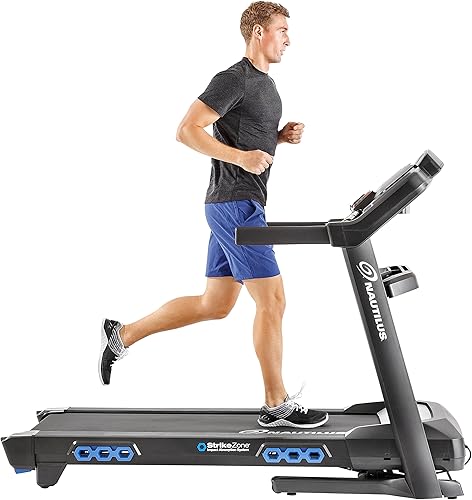
Assembly involves more components than simpler designs, so plan for extra time. Once built, it feels solid and designed to last. If you have joint concerns, it may also be worth comparing this against an elliptical under $1000 — ellipticals offer zero-impact cardio for people with knee or hip sensitivities.
| Pros | Cons |
| It has a real-time heart rate monitor | It might get complicated while assembling. |
| 15° Live incline mode | |
| 3.0 CHP motor with a speed controller |
The Sunny SF-T7515 is the most compact option here. It folds completely flat using a folding key mechanism, making it the natural pick if you're working with limited square footage. The 17.7-inch belt is narrower than average, so if you have a wide natural stride, test your comfort level before committing. Speed adjustment is smooth, but there's no incline capability — this machine runs flat only.
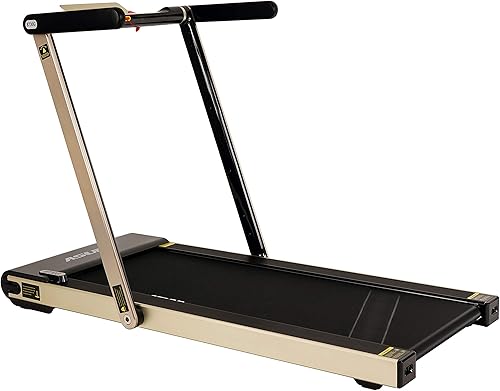
The 220 lb weight capacity is the most significant constraint. If you're near that ceiling, the Nautilus or Schwinn are safer choices. There's also no heart rate monitor, which is worth factoring in if you use heart rate zones for training guidance.
| Pros | Cons |
| It's completely flat foldable with folding key | 220 lbs weight capacity can bother you. |
| Low profile 17.7 inches space-saving belt | It has no heart rate, monitor |
| Good speed adjustment controller |
The ProForm 505 CST earns its place with a notably spacious running surface and an ergonomic control layout. The speed and incline buttons sit directly under your fingers on the handlebars, so you can adjust without breaking your stride. The extra-long safety handles stand out as a genuine advantage for anyone who needs balance support — especially relevant if you're recovering from a lower-body injury or managing a condition that affects stability.
| Pros | Cons |
| It has a big space inside | Its assembly process can be a hectic job! |
| Controllers right under the fingers | |
| Extra-long safe handles |
The Schwinn 830 pairs a spacious stride belt with a 12 mph top speed, making it one of the more capable machines at this price point for people who want the option to run. Pulse monitors are integrated into the handlebars for on-demand heart rate checks, and both speed and incline are controllable from the grip area. At 300 lbs weight capacity, it covers most users comfortably. A few reviewers note the 300 lb limit feels conservative given the frame size, but that's a minor note against an otherwise strong package.

| Pros | Cons |
| The stride belt is very specious | 300 lbs user weight capacity isn't enough for it |
| Pulse monitors are right under the fingers | |
| The speed and incliner are impressive |
This belief comes from experiences with the cheapest category — machines under $300 with tiny motors and single-ply belts. The five models above occupy a different tier entirely. With basic maintenance (belt lubrication every 150 miles, motor housing kept dust-free), machines in the $500–$900 range routinely last five to ten years under normal home use. The key is not abusing the motor — running at maximum speed for extended periods is harder on the machine than varied-pace walking.
Commercial gym treadmills are engineered for eight-plus hours of daily use across dozens of users. Home treadmills are built for one to two hours of use per day by one or two people. That's all most people actually need. If you want to compare motorized treadmills to a manually-powered alternative, our guide on the best manual treadmills for home gyms breaks down the tradeoffs clearly — manual machines have their own advantages for certain training goals.
Built-in touchscreens, app subscriptions, and Bluetooth speakers are appealing extras, but they're also the first components to malfunction and the hardest to repair out of warranty. If long-term reliability matters to you, a machine with a strong motor and straightforward controls will outlast a gadget-loaded competitor at the same price point. Pay for the motor. Let the technology be a bonus, not the reason you buy.
Always look for continuous horsepower (CHP), not peak HP. For walking-focused use, 1.5–2.0 CHP is adequate. For jogging, you want at least 2.5 CHP for sustained comfort. Belt thickness is equally important: a 2-ply belt (two layers) absorbs impact better than single-ply and resists stretching over time. This matters especially if you're using the machine daily or if you weigh more than 200 lbs.
If you deal with any joint pain — particularly in the knees, hips, or lower back — deck cushioning should be near the top of your checklist. Cushioned decks (sometimes marketed as orthopedic or cushion-flex belts) absorb a significant portion of the impact from each footfall. Pairing your treadmill use with the right shoes for back pain extends that protection further — footwear and surface quality work together.
Measure both your available floor space and your doorway width before you order. Most of these machines require a clearance of at least 32 inches to get through a standard doorway during delivery. The unfolded running footprint is typically 60–70 inches long by 28–35 inches wide — roughly the size of a large coffee table. If your space is tight, the Sunny SF-T7515's flat-fold design is the most space-efficient here.
Pro tip: Treadmills placed directly on hard flooring transmit vibration and noise more than those on a rubber mat — a $20–30 equipment mat reduces both significantly and protects your floor at the same time.
If you're new to treadmill exercise or returning after time off, start at a comfortable walking pace for 15–20 minutes and build duration before you raise speed. Incline is a smarter way to increase intensity than speed: a 5–7% grade at a moderate walk burns comparable calories to a light jog on flat ground, with noticeably less impact on your lower body. Your joints will appreciate the slower progression.
Regular belt lubrication is the single most impactful thing you can do to extend your treadmill's life. Apply silicone lubricant (not WD-40) to the underside of the belt every 150 miles or every three months. Keep the area around the motor housing clear of dust and pet hair — this alone can add years to motor life. Check belt tension periodically: a belt that's too loose slips, and one that's too tight puts extra load on the motor.
Treadmill walking is excellent for cardiovascular health, but it works best as part of a broader movement routine. Low-impact strength training, stretching, and cross-training on different cardio equipment all complement your treadmill sessions. If you're looking for a lower-body companion machine, our guide to the best recumbent bikes for home cardio covers seated cycling options that are especially gentle on the hips and knees.
If the belt slips or the machine hesitates when you step on it, start with lubrication — apply silicone spray to the underside and run the belt for two minutes at a slow speed. If slipping continues, the rear roller tension bolts may need a quarter-turn clockwise adjustment. Consult your manual first; different machines specify different torque. Overtightening is a common DIY mistake that accelerates belt wear.
A rhythmic squeak usually means the belt is rubbing against the side frame — check that the belt is centered using the alignment bolt at the rear. A grinding sound from the motor area is more serious and typically indicates debris in the motor housing or a failing bearing. Don't ignore grinding: running a machine with a compromised bearing can cause more expensive damage. Contact customer support if a thorough cleaning doesn't resolve it.
Most error codes on budget treadmills are resettable. An E1 or speed sensor error — among the most common — often clears after you unplug the machine for 30 seconds and restart. If the error persists, the speed sensor magnet on the front roller may have shifted out of position. This is a straightforward fix covered in most user manuals and requires no special tools. Only escalate to a repair call if the error recurs after two or three reset attempts.
Walking is one of the most consistently evidence-backed activities for people dealing with musculoskeletal pain. It improves circulation, reduces stiffness, and supports joint health without the high-impact stress of running. A home machine removes the friction of traveling to a gym, which matters when motivation is already a challenge on difficult pain days. You control every variable: speed, incline, duration, and when you stop.
Weather, gym hours, and commute time become irrelevant when your treadmill is in the next room. For parents managing young children, shift workers, or anyone whose schedule varies week to week, a home machine removes the biggest obstacle to consistency: just showing up. Even a 20-minute walk at 6 a.m. before anyone else wakes up adds up to meaningful weekly activity totals.
Modern home treadmills include safety features — emergency stop keys, side handrails, and gradual speed ramp-up — that make them well-suited for older users or people who are just starting an exercise habit. The long side rails on the ProForm 505 CST are a genuine standout for balance support. For people who need additional mobility support beyond exercise equipment, our overview of walker benefits and mobility aids covers complementary tools worth knowing about.
A $300 treadmill with a 1.5 HP motor will likely become a frustration within a year of regular use. Motors that run near their maximum rating continuously overheat and wear out faster. Spending $150–200 more on a 2.5 CHP motor buys you years of reliable use rather than a repair decision eighteen months in. The best treadmills under $1000 sit comfortably in the $500–900 range for exactly this reason — you're paying for sustainable performance, not just a belt that moves.
Starting at full speed puts immediate stress on both your cardiovascular system and the machine's motor. Begin every session at 1–2 mph for three to five minutes, then gradually increase. End the same way — a slow walking cooldown before you stop fully protects your heart rate recovery and reduces belt wear from abrupt load changes. If you experience foot or heel discomfort during treadmill sessions, check our guide on the best shoes for back pain — cushioning and arch support make a tangible difference on a treadmill surface.
Every treadmill lists a maximum user weight, and exceeding it stresses the motor, frame, and belt simultaneously — while voiding your warranty. The Sunny SF-T7515's 220 lb limit is the tightest on this list; if you're at or above that threshold, the Nautilus T616 at 350 lbs gives you real headroom. Choosing the right capacity isn't about body image — it's about getting full value from a machine that's actually rated for your use.
Finding the right treadmill under $1,000 comes down to matching the machine's specs to your actual situation — your weight, your space, your joint health, and how you plan to use it. Start with the comparison table, eliminate anything that doesn't meet your weight capacity needs, and then read through the relevant product sections above. Once you've narrowed it down, check current pricing and recent buyer reviews for any updates since this guide was written, then place your order with confidence. A solid home treadmill is one of the most consistent investments you can make in your long-term health — and the right one is well within your budget.


About Mehnaz
Mehnaz is the founder and editor of RipPain, a health resource site dedicated to helping readers navigate pain management, recovery, and medical device research. Her work on the site is driven by personal experience caring for seriously ill family members, which led her to study evidence-based guidance from physicians, pain specialists, and published medical research. She curates and summarizes expert medical insights to make credible health information accessible to everyday readers.
You can get FREE Gifts. Or latest Free phones here.
Disable Ad block to reveal all the info. Once done, hit a button below
 Mehnaz